
Types of Boots
By Tamer Mourshed - Master Leather Craftsman, Lebanon Leather Work | Lebanon, NJ. Read time: ~14 minutes
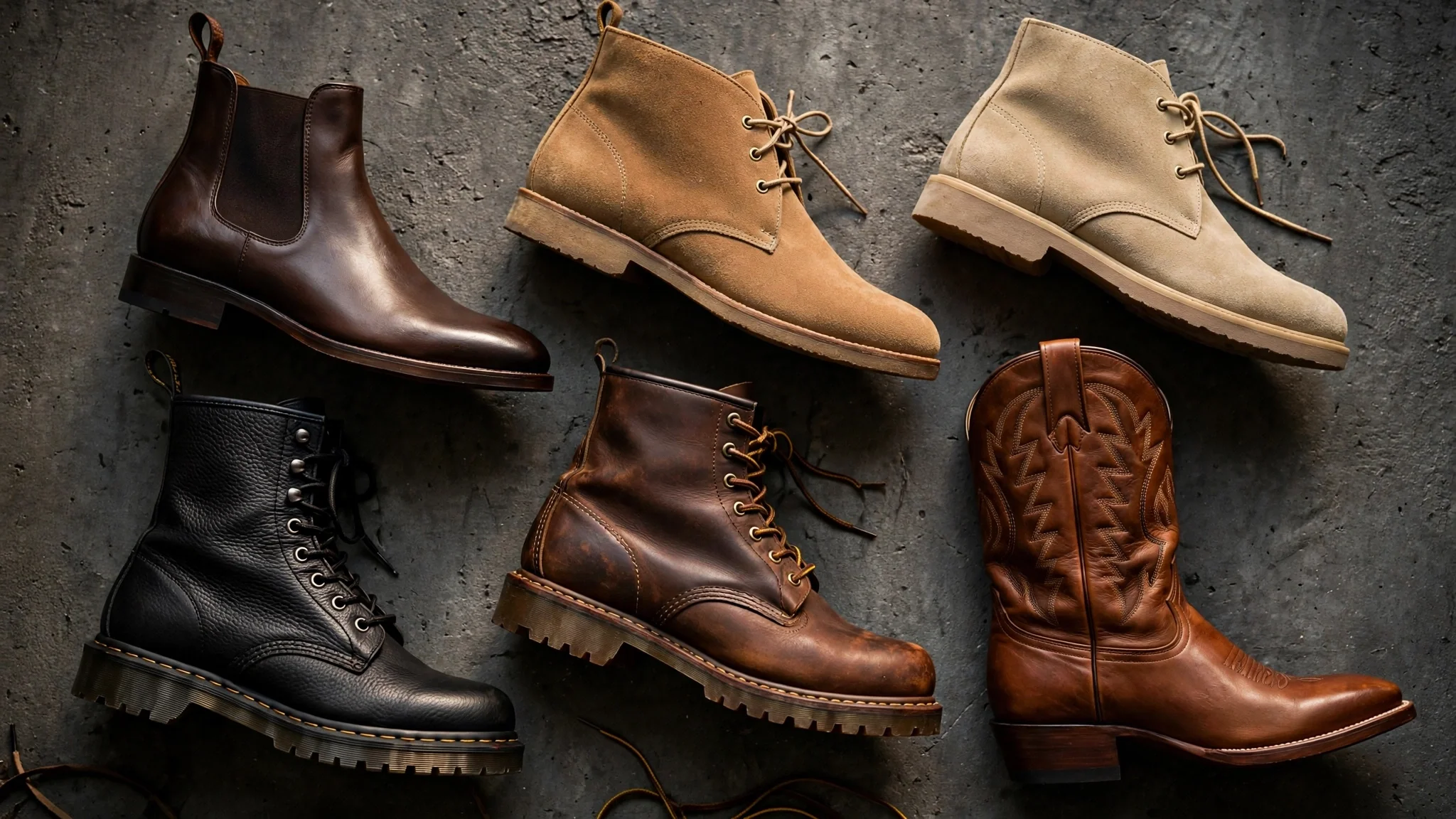
The Complete Guide to Every Style, Construction, and Leather Quality. The main types of boots are Chelsea, ankle, chukka, work, combat, cowboy, riding, hiking, engineer, jodhpur, dress, wingtip, moc toe, knee-high, over-the-knee, snow, rain, and platform boots. They differ by shaft height, construction method, leather grade, and intended purpose. The construction method - Goodyear welt, Blake stitch, or cemented adhesive - determines whether a boot can be re-soled and how long it will last.
The word "boots" covers more ground than most people realize. Chelsea boots and combat boots have almost nothing in common beyond covering the foot and ankle. A Goodyear-welted work boot built to last thirty years and a cemented fashion boot built for one season are both "boots" - but they are entirely different investments.
This guide covers the full picture: every major boot type, the leather grades and construction methods that determine how long each one lasts, how to choose the right style for your needs, and how custom-made leather boots - something we build at our Lebanon, NJ workshop - fit into the picture. Unlike most boots’ guides, this one is written from a craftsman's perspective rather than a fashion editors. The goal isn't just to name the styles. It's to help you understand what you're actually buying.
The 4 Categories of Boots by Height
Before diving into individual styles, a quick structural framework. Boots are grouped by how far up the leg the shaft reaches. Most style names sit within one of these four categories:
Ankle boots (4–6 inches): The most versatile category. The shaft ends at or just above the ankle. Chelsea, chukka, desert, jodhpur, engineer, and most cowboy boots all fall here.
Mid-calf boots (10–14 inches): The shaft reaches between ankle and knee. Work boots, combat boots, logger boots, and harness boots typically fall in this range.
Knee-high boots (15–18 inches): The shaft rises to the knee. Classic equestrian boots, tall fashion boots, and waders start here.
Over-the-knee and thigh-high boots (18 inches+): The shaft extends above the knee, reaching mid-thigh or higher. Primarily fashion-forward styles, though some equestrian and wading boots reach this height for functional reasons.
18 Types of Boots Explained: Style, Purpose, and What to Expect
1. Chelsea Boot
The single most versatile boot in existence.
Ankle-high with elastic side panels on each side - no laces, no buckles, no zippers. It slips on and off in seconds and works with everything from tailored trousers to denim to dresses. The Chelsea boot originated in Victorian England and was revived in the 1960s by The Beatles. It has never gone out of fashion and shows no sign of doing so.
Best for: Daily wear, office, smart casual, most social occasions. Appropriate for men and women.
Leather grade typically used: Full-grain or top-grain calfskin in quality versions.
Construction to look for: Goodyear welt or Blake stitch. A well-made Chelsea boot should last a decade or more and resole multiple times.
Longevity notes: A quality Chelsea boot properly maintained is a 15–20-year purchase. A fast-fashion Chelsea with cemented soles is a 2-year purchase. Same style name; entirely different objects.
2. Ankle Boot
Ankle boots share the Chelsea's height but use a zipper, lace, or buckle instead of elastic panels. The closure creates a snugger fit that some find more secure and others find less convenient. Ankle boots span a wider stylistic range than any other category - block heel, stiletto, flat, mock toe, brogue, or cap toe. They are the broadest sub-genre of the boot world.
Best for: Transitional seasons, casual to smart casual wear.
Leather grade: Varies widely by price point.
Construction to look for: Visible welt stitching signals resoleable quality construction.
3. Chukka Boot and Desert Boot
Ankle-high with open lacing - typically 2–3 eyelets - and most commonly made from suede with a crepe sole. The most famous expression is the Clarks Desert Boot, which became one of the most-produced footwear styles of the 20th century.
The chukka's origin is debated - some trace it to polo, others to British officers in North Africa during World War II who wore similar unlaced boots informally. Either way, the chukka has remained a semi-casual staple for generations.
Best for: Casual to smart casual. Particularly well-suited to chinos and informal trousers.
Leather grade: Most commonly suede; also available in smooth leather.
Construction note: Resole able when built with quality construction. Suede uppers require more careful maintenance than smooth leather - a suede brush and water-repellent spray are non-negotiable.
4. Work Boot and Logger Boot
Work boots are built for a job first and style second - though the best examples do both well. Core features include heavy-duty full-grain leather uppers, protective toe boxes (steel, alloy, or composite), thick rubber lug soles, and construction designed to withstand demanding physical environments.
The logger boot variant adds a raised heel specifically for forestry and slope work, providing leverage and stability on uneven ground. Brands including Red Wing, Whites, Danner, and Wesco have built their entire reputations on work boot construction that has simultaneously crossed over into heritage casual wear.
Best for: Construction, forestry, farming, trades. Also widely worn as casual heritage footwear.
Leather grade: Full-grain leather - nothing else is appropriate for serious work boot use.
Construction to look for: Goodyear welt or stitch down. Among the most resole able and longest-lasting boot styles when built properly.
Longevity notes: A quality work boot under regular professional use should last 10–15 years with periodic resoling. Under casual or light use, 25–30 years is realistic.
5. Combat Boot
Originally military footwear designed for soldiers in combat conditions, the combat boot entered mainstream fashion in the 1960s and 1970s and has remained there. Key features: lace-up front, ankle to mid-calf height, thick rubber lug sole, and a robust silhouette that communicates durability.
Dr. Martens - who built their original boot for factory workers and police officers - brought the aesthetic to wider culture. The style has been in continuous fashion cycles since, associated at various times with punk, grunge, and now mainstream streetwear.
Best for: Casual and streetwear contexts. Pairs with jeans, dresses, and most casual outfits.
Leather grade: Full-grain leather in functional versions; varies widely in fashion versions.
Construction notes: Military-spec combat boots use welted or heavily cemented construction. Fashion combat boots vary significantly - check for welt stitching before buying.
6. Cowboy Boot and Western Boot
Few boot styles have a stronger identity. Defined by a pointed or rounded toe, a Cuban or underslung heel (designed to lock into a stirrup), decorative shaft stitching, and no lacing, the cowboy boot originated on American cattle ranches in the mid-1800s.
Every feature is functional in origin: the angled heel prevents the foot from sliding through a stirrup; the smooth leather sole slides cleanly out of a stirrup in a fall; the tall shaft protects the lower leg from brush and trail debris. Cowboy boots range from plain brown calfskin to elaborately embroidered shafts and exotic leathers including alligator, ostrich, and snake.
Best for: Western and country settings, and increasingly mainstream casual fashion.
Leather grade: Typically, calfskin or full-grain cowhide. Exotic versions use specialty skins.
Construction: Hand-stitched versions from specialty makers are among the most durable and customizable boots available. Quality cowboy boots are expected to last decades.
7. Riding Boot and Equestrian Boot
Built for horseback riding with function as the absolute priority rises to the knee, smooth leather sole (to slide cleanly through a stirrup), low and stable heel, and a close fit to the lower leg that provides security in the saddle.
Riding boots crossed into mainstream fashion significantly in the 1970s and 1980s and remain a perennial wardrobe piece, particularly in tall leather form for women.
Best for: Equestrian use (functional), smart casual and fashion (aesthetic).
Leather grade: Full-grain leather for functional riding boots; varying grades in fashion versions.
Fit note: Functional riding boots should fit snugly around the calf. Fashion versions are often wider through the shaft.
8. Hiking Boot and Trail Boot
The hiking boot category spans a wide spectrum - from lightweight trail shoes with leather uppers to heavy-duty mountaineering boots for technical terrain. Core features include ankle support, aggressive traction soles, and construction that resists moisture and abrasion across thousands of miles of use.
Leather hiking boots offer significant advantages over synthetic: superior durability, a more comfortable fit that develops over time as the leather conforms to the foot, and resoleable construction in quality examples. Danner, Vasque, and Whites have built devoted followings for their leather hiking boots.
Best for: Trail use, hiking, outdoor work. Also worn as rugged heritage casual footwear.
Leather grade: Full-grain leather in quality examples.
Construction to look for: Stitch down or Norwegian welt. Vibram soles are the industry reference for traction.
9. Engineer Boot and Harness Boot
One of the few boot styles originating in America. The engineer boot was designed in the early 1900s for railroad workers: tall, laceless shaft (typically mid-calf), a harness strap at the ankle, a substantial heel, and a pull-on design built for demanding daily use.
The engineer boot became associated with motorcycling culture in the 1940s and 1950s. Marlon Brando in The Wild One is the iconic image. Frye remains the most recognized name in this category.
Best for: Motorcycling heritage, casual and counterculture aesthetics.
Leather grade: Thick full-grain leather - among the most ruggedly built casual boots available.
10. Jodhpur Boot
A close relative of the Chelsea boot with equestrian roots. The Jodhpur is an ankle boot with a strap that wraps around the ankle and fastens with a buckle, rather than elastic panels. It originated in India - named after the city of Jodhpur where polo riders first popularized the style.
The Jodhpur boot offers the clean silhouette of the Chelsea with a distinctive finishing detail at the ankle, which makes it slightly more formal and fashion-deliberate.
Best for: Smart casual and business casual. Men and women.
Leather grade: Full-grain or top-grain leather in quality versions.
11. Dress Boot
The dress boot occupies the intersection of boots and formal footwear. It looks like a dress shoe - cap toe, closed lacing, highly polished leather - but rises to cover the ankle. Balmoral boots are the most formal expression of this style, appropriate for pairing with suits and formal trousers.
Where a regular dress shoe leaves the ankle exposed to winter weather, the dress boot covers it while maintaining complete formality.
Best for: Formal and business formal settings, particularly in colder months.
Leather grade: Full-grain calfskin, highly polishable.
Construction: Goodyear welt or Blake stitch construction in quality examples.
12. Wingtip Boot and Brogue Boot
The wingtip brings decorative brogue detailing - perforations along seams and the distinctive W-shaped toe cap - to a boot silhouette. The broguing originated as a functional feature on Irish and Scottish work shoes, allowing water to drain from the perforations when crossing wet terrain.
Wingtip boots sit in a well-defined middle ground: formal enough for office environments, too decorative for black tie, and characterful enough for a smart casual outfit.
Best for: Business casual, smart casual, casual-formal events.
Leather grade: Full-grain leather in quality examples.
13. Moc Toe Boot
Recognized by its distinctive moccasin-style seam around the toe box - a raised cap that follows the contour of the toe. The design originated in Native American moccasin construction and was adapted into work footwear in the 20th century.
The extra toe room and flexible seam make the moc toe boot particularly comfortable for long days on your feet. The Red Wing Moc Toe is probably the most recognized single work boot design worldwide.
Best for: Casual to rugged casual wear, work environments.
Construction: Full-grain leather with Goodyear welt or stitch down - excellent longevity.
14. Knee-High Boot
Knee-high boots rise to the knee - typically 15–18 inches of shaft. They carry more visual weight and presence than ankle styles and work particularly well with dresses, skirts, and slim trousers. In leather, the knee-high boot has been a fashion staple since the 1950s.
Best for: Fashion contexts, transitional and winter wear, equestrian aesthetics.
Leather grade: Full-grain or top-grain leather for quality versions; suede is also common.
15. Over-the-Knee and Thigh-High Boot
Over-the-knee boots extend above the knee; thigh-high variants continue to mid-thigh. These are statement fashion pieces with significant visual impact, most commonly seen in stretch leather or suede. The elongating effect on the silhouette makes them a consistent fashion-world choice.
Best for: Statement fashion, evening wear.
Construction: Often stretch leather or structured suede. Not typically built for longevity the way work or dress boots are.
16. Snow Boot and Winter Boot
Snow boots prioritize warmth and waterproofing above all else. Features include insulated linings (synthetic insulation or sheepskin), waterproof or water-resistant exteriors, and traction soles designed specifically for icy, packed-snow conditions.
The UGG boot is the most recognizable shearling boot globally. At the functional end, brands like Sorel, Baffin, and Kamik make boots rated to -40°F and below.
Best for: Cold, snowy, wet conditions. Warmth and function take precedence over fashion.
Construction: Rubber or waterproof treated leather exterior with natural or synthetic insulation.
17. Rain Boot and Wellington Boot
The Wellington boot - rubber from top to bottom, completely waterproof - is named after the Duke of Wellington, who commissioned a modified cavalry boot design in the early 1800s. Modern wellies are found everywhere from British country estates to music festivals to fishing.
This is the one major boot category that is not leather-based and not resole able by nature - the vulcanized rubber construction is the product.
Best for: Wet conditions, outdoor work, gardening, heavy rain.
Construction: Vulcanized rubber. Functionally irreplaceable for serious wet weather; not a long-term leather investment.
18. Platform Boot and Wedge Boot
Platform boots add significant sole height - typically 1–4 inches - beneath the entire foot. Wedge boots replace the separated heel with a continuous wedge sole running the full foot length. Both styles have roots in 1970s fashion and have been through multiple revival cycles since.
Platform boots add height without the ankle instability of a high stiletto, which makes them more practical than their visual drama suggests.
Best for: Statement fashion occasions. Construction: Varies widely. Quality examples use leather uppers with durable platform construction.
Leather Grades for Boots: What Determines How Long They Last
Most boots guides don't cover this - and it's arguably the most important factor when buying leather footwear.
Full-grain leather is the highest grade. The natural grain surface is untouched - no sanding, no buffing, no correction. Full-grain leather develops a patina over time, resists moisture better than lower grades, and lasts decades when properly cared for. All quality work boots, dress boots, and craft-made footwear use full-grain leather.
Top-grain leather has had the surface lightly sanded to remove imperfections, then is given a protective finish coat. Slightly more uniform in appearance than full-grain but less durable over the long term. Standard in mid-range leather boots.
Corrected-grain leather has been heavily sanded and given an embossed artificial grain. Significantly less durable than full-grain or top-grain. Common in budget and fashion footwear - you can often identify it by its perfectly uniform, almost plastic-looking surface.
Suede comes from the underside of a hide - soft, napped, and casually elegant. Less moisture-resistant than smooth leather, requires different care, and is more prone to staining. But develops a beautiful worn quality over time that smooth leather cannot replicate.
Nubuck is full-grain leather buffed on the grain side to create a soft, velvety surface similar to suede but more durable. A strong middle ground between smooth leather and suede, used in quality hiking boots and casual dress shoes.
For a complete breakdown of how to identify leather grades by sight and touch, see our guide to types of leather - published specifically for people who want to make better buying decisions.
Boot Construction Methods: The Factor That Separates a Lifetime Boot from a Season Boot
This is the section no competitor covers - and the single most important buying decision in leather footwear.
Goodyear Welt Construction
The gold standard. A strip of leather (the welt) is sewn around the perimeter of the upper and insole. The outsole is then stitched to the welt - two separate stitch lines, two separate points of structural integrity. The cork midsole molds to the shape of your foot over time.
The result: a Goodyear-welted leather boot can be resoled repeatedly by a skilled cobbler without damaging the upper. With proper care and periodic resoling, this construction method produces boots that last 20–30 years or more. Look for visible stitching running along the welt - that seam is your guarantee.
Used in: Work boots, quality Chelsea boots, dress boots, moc toe boots, quality chukka boots.
Blake Stitch Construction
A single stitch connects the upper, insole, and outsole directly - no separate welt. The result is a slimmer profile and more flexibility than Goodyear welt, which suits dress boots and Chelsea boots particularly well aesthetically.
Blake stitched boots are resoleable but require specialist equipment that not every cobbler has. Slightly less water-resistant than Goodyear welt because the stitch runs through the insole. Still produces a durable, quality boot with a longer life than any cemented construction.
Used in: Quality dress boots, many Chelsea boots, higher-end fashion boots.
Norwegian Welt and Stitch down Construction
Variations of welted construction used primarily in serious outdoor footwear. The stitch down method - where the upper is folded outward and stitched directly to the midsole — creates an exceptionally flexible and water-resistant boot ideal for hiking and heavy outdoor work.
Used in: Hiking boots, hunting boots, heavy outdoor boots.
Cemented / Adhesive Construction
The sole is bonded to the upper with industrial adhesive. No stitching connects sole to upper. This is the most common construction method in mass-market footwear - fast to produce, inexpensive, and lightweight.
The significant limitation: when the adhesive bond fails - typically at 2–4 years under regular use - the boot cannot be meaningfully resoled. The life of the boot ends when the sole goes.
How to spot it: If there is no visible stitching running along the welt between the upper and the sole, the boot is almost certainly cemented. The absence of that stitch is the tell.
Used in: Budget and fashion footwear across all styles.
The check before you buy: Turn the boot over and look at the welt - the border between the upper and the sole. Visible stitching means resoleable construction and a long-term investment. No stitching means cemented construction and a replacement cycle. This single check is worth more than any other boot-buying advice. For more on what cobblers can and can't fix, see our complete shoe and boot repair guide.
Custom-Made Leather Boots: The Option Most People Don't Know Exists
There is a category of boot beyond anything sold in a store: boots built specifically for your feet, your measurements, and your exact specifications.
At Lebanon Leather Work, we make bespoke leather boots from scratch. The full craft process: you choose the style, the leather grade and color, the sole type and construction method, the heel height, the toe shape, and any additional details - decorative stitching, personalization, hardware. We build on measurements taken of your specific feet, not a standardized last.
The result fits your foot precisely - not a foot that happens to be the same size as yours. For people with wide or narrow feet, a significant size difference between their two feet, a high instep, or who simply want footwear that reflects their exact preferences, custom-made boots are something no retail option can replicate.
Custom boots take time. From initial consultation to finished pair, expect 6–8 weeks. They cost more than off-the-shelf boots in the same quality range. And they last significantly longer, because they are built to the highest construction standards available - full-grain leather, Goodyear welt, resole able from day one.
If you have ever looked at the boot section of any store and found nothing that fits correctly, or nothing that matches your vision, this is the answer.
Inquire about a custom leather boot commission →
How to Choose the Right Type of Boot
With this many options, here is a practical framework for narrowing the field.
Start with purpose. Are you buying boots for daily wear, a specific outdoor activity, formal occasions, or general casual use? Purpose eliminates most of the field immediately. Physical protection or outdoor work → work boot or hiking boot. Cold wet winters → snow boot or waterproof leather boot. Most office and social contexts → Chelsea, chukka, or ankle boot.
Check the construction before the style. A beautiful boot in the wrong construction is a short-term purchase. Look for welt stitching. If it's there, you're looking at a long-term investment. If it's not, manage your expectations accordingly.
Match the leather grade to the lifespan you want. Full grain for longevity. Top-grain for mid-range balance. Suede for casual character and a specific aesthetic. Avoid corrected-grain for anything you intend to wear regularly for more than two seasons.
Choose height and silhouette for your wardrobe. Chelsea and chukka boots are the most versatile. Knee-high and over-the-knee are statement pieces that require deliberate outfit planning. Dress boots and wingtips occupy specific formal-to-smart-casual territory
How Long Each Type of Leather Boot Should Last
| Boot Type | Typical Lifespan | With Quality Construction & Maintenance |
|---|---|---|
| Work boot (full-grain, Goodyear welt) | 10–15 years | 25–30+ years with periodic resoling |
| Cowboy boot (calfskin, hand-stitched) | 10–20 years | Decades with proper care |
| Chelsea boot (quality leather, welted) | 7–12 years | 20+ years with periodic resoling |
| Dress boot (full-grain, Blake or Goodyear) | 8–15 years | 20+ years |
| Combat boot (full-grain, welted) | 8–15 years | 20+ years |
| Moc toe boot (full-grain, welted) | 10–20 years | 25+ years |
| Chukka boot (suede, quality construction) | 4–8 years | 10+ years with careful maintenance |
| Hiking boot (full-grain, stitchdown) | 5–10 years | 15+ years with resoling |
| Engineer / harness boot (full-grain) | 10–20 years | 25+ years |
| Fashion ankle boot (cemented construction) | 1–3 years | Not resoleable — replacement cycle |
| Snow boot (rubber/insulated) | 5–10 years | Material-dependent; not resoleable |
| Rain boot (vulcanized rubber) | 5–10 years | Not resoleable by nature |
The core math: A $350 Goodyear-welted leather boot resoled at year 6 for $120 costs $470 across 20+ years of wear. Four pairs of $150 cemented fashion boots over the same period costs $600 - and none of them will fit as well as the broken-in welted pair at year 8.
How to Care for Your Leather Boots
Smooth full-grain and top-grain leather: Condition every 3–4 months with a dedicated leather conditioner - not furniture polish, not household oil, not multipurpose spray. Apply wax-based polish over conditioning for shine and surface protection. Store on cedar shoe trees to maintain shape and absorb moisture between wears.
Suede and nubuck: Use a suede brush (brush in one direction to restore the nap, not in circles). Protect with a suede-specific water-repellent spray before first wear and refresh seasonally. Never use smooth leather conditioners on suede - the oils will stain and flatten the nap permanently.
Work boots in daily professional use: Clean thoroughly after each use in demanding conditions. Condition once a month - far more frequently than dress boots, because the exposure is constant. Replace laces before they fail, particularly in safety-critical work environments.
Exotic leathers (ostrich, alligator, snake): Use specialist care products matched to the specific leather type. Standard conditioners can damage exotic finishes. When in doubt, bring them to a professional before attempting home care.
For stain-specific guidance on leather footwear, our leather stain removal guide covers safe approaches by stain type and leather grade.
Repair Rather Than Replace: The Decision That Matters
Every quality leather boot deserves consideration before it is discarded. A worn heel tip costs $15–$30 to replace. A full resole on a Goodyear-welted boot costs $65–$150 and restores another 5–10 years of life. Color restoration and reconditioning for faded or scuffed leather can make a boot look nearly new.
The only boots that genuinely cannot be meaningfully repaired are those built with cemented (glued) construction — once that adhesive bond fails, the boot's structural life is over regardless of the condition of the upper.
Quality leather boots - Goodyear welted, Blake stitched, or stitch down - are worth repairing. Every time.
Our Lebanon, NJ workshop handles boot and shoe repair across all the styles covered in this guide. See our shoe and boot repair service →
Commission a Pair Made for You
Whether you are looking for a Chelsea boot in a leather color that doesn't exist in stores, a pair of work boots built precisely to your feet, or something entirely original that you've had in mind for years - we take custom leather boot commissions at our Lebanon, NJ workshop.
The process begins with a conversation. Walk in, call, or email us and we'll talk through your vision, the materials, the construction, and a realistic timeline and cost. Nothing is committed until you say so.
Workshop: 1271 US-22, Lebanon, NJ 08833
Email: lebanonleatherwork@gmail.com
Phone: (551) 333-8186
Instagram: @lebanonleatherworkllc
Inquire about a custom leather boot commission →
Frequently Asked Questions
What are the main types of boots?
The main types of boots are Chelsea boots (elastic side panels, ankle height), chukka and desert boots (open lacing, usually suede), work boots (heavy-duty, protective toe, lug sole), combat boots (military-inspired, lace-up, ankle to mid-calf), cowboy boots (Cuban heel, decorative stitching, no lacing), riding boots (knee-high, smooth sole, low heel), ankle boots (various closures, broad style range), hiking boots (aggressive traction, ankle support), dress boots (formal, cap-toe, closed lacing), moc toe boots (distinctive moccasin seam, comfortable toe room), and knee-high or over-the-knee fashion boots. Platform, wedge, snow, and rain boots are further categories for specific style or weather purposes.
What is the most versatile type of boot?
The Chelsea boot is the most versatile boot for everyday wear. Its clean silhouette, elastic side panels, and ankle height work with casual, smart casual, and business casual outfits for men and women alike. A full-grain leather Chelsea boot in brown or black is the single best boot investment for someone buying their first quality pair.
What is the most durable type of leather boot?
Durability is determined more by construction method and leather grade than by style. A Goodyear-welted full-grain leather boot - whether it is a work boot, Chelsea, or moc toe - will outlast any cemented boot of the same style by 10–20 years. The construction method is the primary driver of lifespan. Look for visible stitching along the welt between the upper and the sole.
What is Goodyear welt construction and why does it matter?
Goodyear welt construction is a method of attaching a boot's sole to its upper using a strip of leather (the welt) stitched around the perimeter. The outsole is then stitched to the welt, creating two separate stitch lines. This allows the sole to be removed and replaced by a cobbler without damaging the upper - making the boot resole-able multiple times over decades. A Goodyear-welted full-grain leather boot can last 20–30 years or more with proper care and periodic resoling. It is considered the highest-quality construction method for everyday leather boots.
What is the difference between Chelsea boots and ankle boots?
Chelsea boots are a specific type of ankle boot defined by elastic side panels with no laces, buckles, or zippers. "Ankle boot" is the broader category that includes all boots reaching to the ankle with any closure type. All Chelsea boots are ankle boots, but not all ankle boots are Chelsea boots. The distinction matters because the elastic panel gives the Chelsea its distinctive clean, unbroken silhouette that other ankle boot closures cannot replicate.
How long should leather boots last?
A full-grain leather boot with Goodyear welt or Blake stitch construction should last 10–20 years under regular wear, with periodic professional resoling extending that lifespan significantly. Quality work boots and cowboy boots built by specialty makers can last 30 years or more. Cemented fashion boots typically last 2–4 years, as the adhesive bond is not resoleable once it fails. The construction method - not the price, brand name, or style - is the primary determinant of lifespan.
Can you get custom-made leather boots?
Yes. Custom leather boots - where the style, leather grade, color, sole type, construction method, and fit are all specified by you - can be commissioned from skilled leather craftsmen. Lebanon Leather Work in Lebanon, NJ accepts custom boot commissions built to your exact foot measurements and design specifications. The process takes approximately 6–8 weeks and results in boots fitted precisely to your feet rather than a standardized last. Learn more about our bespoke leather goods and custom boot service.
What leather is best for boots?
Full-grain leather is the best leather for boots. It retains the natural grain surface, develops a rich patina over time, resists moisture better than lower grades, and is significantly more durable than corrected grain or bonded leather. Calfskin full grain is the most common choice for dress and Chelsea boots. Thicker full-grain cowhide is used for work boots and cowboy boots where durability under heavy use is required. Suede (from the underside of a hide) offers a soft, casual character but is less moisture-resistant and requires different care.
How do I know if my boots can be repaired?
Look for visible stitching running along the welt - the border between the upper and the sole on the outside of the boot. If stitching is visible there, the boot is likely Goodyear or Blake welted and can be re-soled by a skilled cobbler. If the sole looks seamlessly bonded with no visible seam stitching, the boot was likely built with cemented adhesive construction and has very limited repair options. Our shoe and boot repair guide covers this in complete detail.
Do leather boots get more comfortable over time?
Yes - and this is one of the key advantages of genuine leather over synthetic materials. Full-grain and top-grain leather boots break in over the first few weeks of wear, conforming to the specific shape of your foot. A Goodyear-welted boot with a cork midsole mold even more precisely over time, as the cork compresses to your footprint. This is why well-maintained quality leather boots often become more comfortable after a year than they were on day one - the opposite of how synthetic and bonded leather footwear typically behaves.