
Types of Leather
By Tamer Mourshed - Master Leather Craftsman, Lebanon Leather Work | Lebanon, NJ Read time: ~15 minutes
Leather is not a single material. It is a broad family of products - separated by which layer of the hide they come from, how they are tanned, and what finish is applied. Understanding these differences is what separates a purchase you keep for 30 years from one that starts peeling in three. After decades of repairing, restoring, and handcrafting leather goods at our workshop in Lebanon, NJ, we have handled just about every type of leather that exists. Vintage briefcases and designer handbags. Leather sofas that have survived two families. Jackets that were bought before the owner's kids were born.
What we see most often is this: people buy something without knowing what leather it is, and then they're surprised when it fails - or surprised that it can be saved. The type of leather something is made from determines how it ages, how it wears, and whether or not it can be properly repaired when the time comes. This guide covers every major type of leather you will encounter as a buyer or owner. We cover the grades, the tanning methods, and the specialty finishes - plus some thing’s competitors writing on this topic tend to skip, like how to identify leather quality yourself, how each type of actually ages over time, and what kind of professional repair each leather type typically needs.
A Quick Note on Scale
The global leather goods market was valued at approximately $409.7 billion in 2024 and is projected to grow to $614.5 billion by 2033. (Source: IMARC Group) With that much money in play and that much variety on shelves, knowing exactly what you're buying - and what it's worth - has never mattered more.
Quick Reference: Every Leather Type at a Glance
| Leather Type | Source Layer | Durability | Patina Development | Best Used For |
|---|---|---|---|---|
| Full-Grain | Outermost | ★★★★★ | Yes - rich & natural | Premium bags, belts, shoes, furniture |
| Top-Grain | Just below surface | ★★★★☆ | Minimal | Handbags, fashion accessories, upholstery |
| Corrected-Grain | Surface (buffed) | ★★★☆☆ | No | Furniture, everyday bags |
| Genuine Leather | Inner layers | ★★☆☆☆ | No | Budget accessories, wallets |
| Split Leather | Bottom layers | ★★☆☆☆ | No | Linings, suede base, work gloves |
| Bonded Leather | Scraps + adhesive | ★☆☆☆☆ | No | Budget furniture (not recommended) |
| Nubuck | Top grain, sanded | ★★★★☆ | Subtle | Shoes, jackets, premium bags |
| Suede | Inner/split layer | ★★★☆☆ | No | Shoes, jackets, accessories |
| Patent | Any base, lacquered | ★★★☆☆ | No | Formal shoes, evening bags |
| Aniline | Full-grain, dye only | ★★★★★ | Yes - very visible | Luxury furniture, heirloom goods |
| Semi-Aniline | Full/top-grain + light coat | ★★★★☆ | Subtle | Quality furniture, upholstery |
| Vegetable-Tanned | Any grade, plant tannins | ★★★★★ | Yes - develops over years | Belts, wallets, saddles, holsters |
| Chrome-Tanned | Any grade, chromium | ★★★★☆ | Minimal | Shoes, jackets, most commercial goods |
| Exotic (croc, python, etc.) | Varies by species | ★★★★★ | Varies | Luxury fashion, statement accessories |
| Faux / Vegan | No animal hide | ★★☆☆☆ | No | Budget fashion, vegan alternatives |
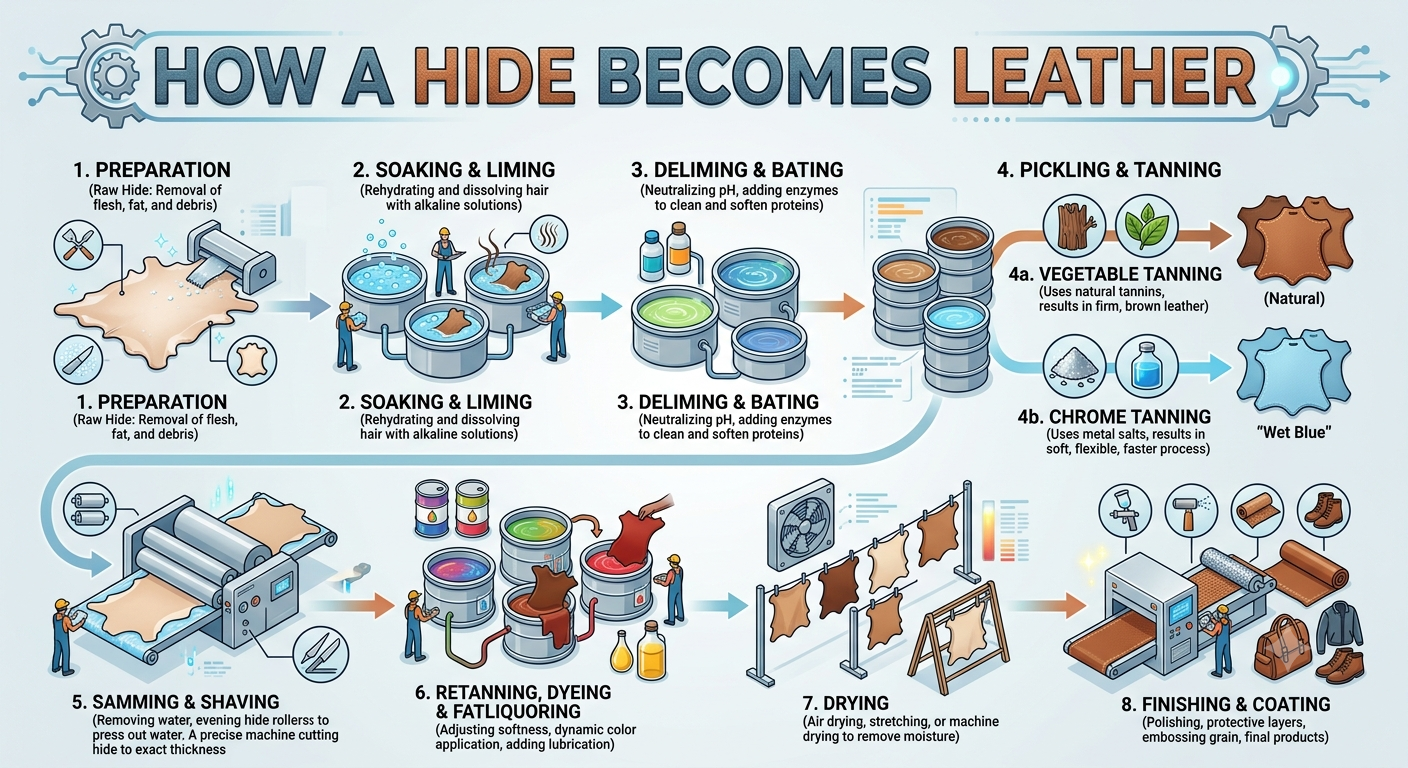
How a Hide Becomes Leather (The Basics)
Animal hides are treated - first cleaned, then tanned, then finished - to become leather. The layer of the hide used and how it's treated determines the grade and quality.
Before getting into the types, it helps to understand the basic structure of a hide. An animal hide has layers. The outermost layer - closest to the surface - has the tightest fiber structure, the most natural strength, and the most character. The deeper you go into the hide, the looser and weaker the fibers get.
When a hide is processed:
The top surface becomes full-grain or top-grain leather
The bottom portion becomes split leather (and the base for suede)
Leftover scraps are ground up and bonded into bonded leather
After splitting, hides go through tanning - which is what actually preserves the hide and makes it leather. The two main methods are vegetable tanning (using natural plant tannins, slow) and chrome tanning (using chromium salts, fast). More on both below. Finally, finishes and dyes are applied - and this is where aniline, semi-aniline, patent, nubuck, and suede come in.
Part 1: The Leather Grade Hierarchy
1. Full-Grain Leather
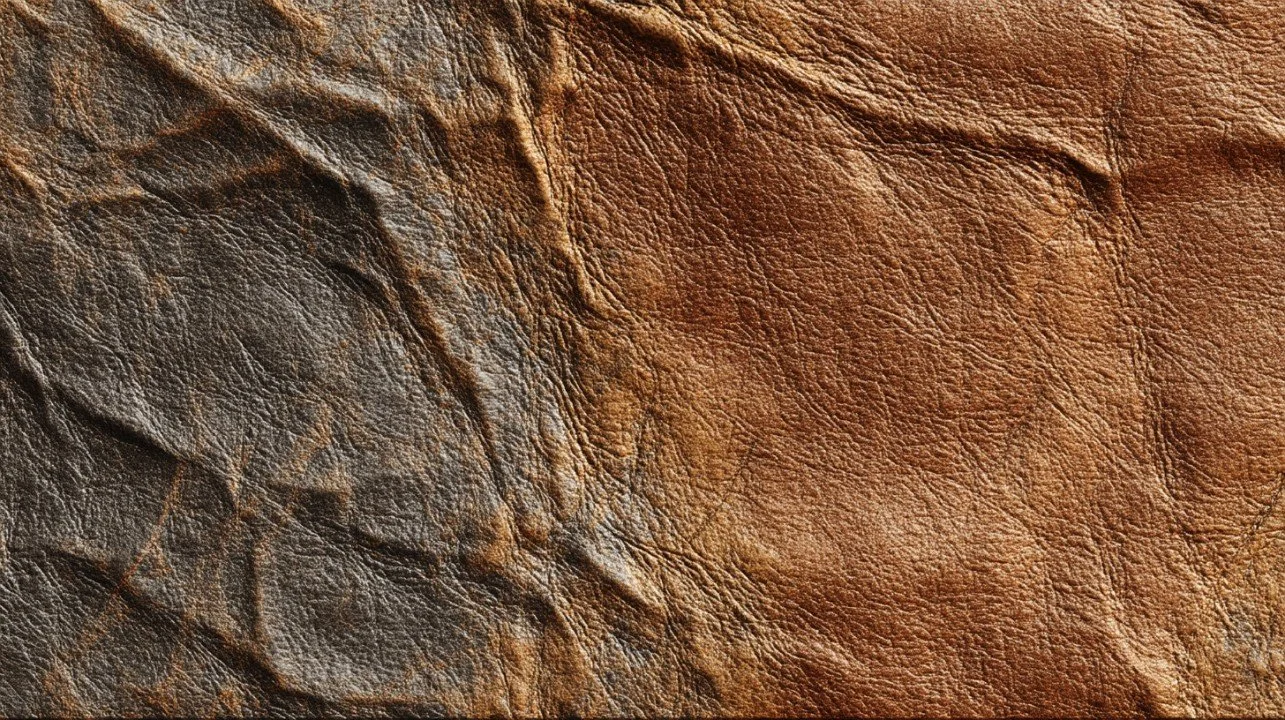
The best leather you can buy. It comes from the very top layer of the hide with the natural grain completely intact - no sanding, no buffing, no corrections. It is the most durable, most breathable, and the only type that truly develops a rich patina over time.
Full-grain leather is the standard by which all other leather is measured. Because the full thickness of the hide's surface is preserved, the fiber structure is incredibly dense and strong. It also means the leather breathes naturally - important in shoes and furniture - and it develops a patina unique to how you actually use it. Importantly, full-grain leather retains its natural imperfections: faint scars, grain variations, small marks. These are not flaws. They are proof that the hide is genuine and untouched. Only approximately 1–13% of any cowhide qualifies as full-grain, which is why it carries a premium price.
What to expect over time: Full-grain leather improves with age. After a few years, it develops a warm, burnished patina that cheaper leather simply cannot replicate.
Common uses: Premium handbags, heirloom belts, quality shoes and boots, high-end furniture, briefcases.
Repair note: Full-grain leather is the most repairable. Its tight fiber structure accepts conditioning, stitching, and color treatment well. A good craftsman can restore full-grain leather goods significantly even after years of wear. If you own something in full-grain leather that needs attention, our leather repair service can restore it properly.
2. Top-Grain Leather
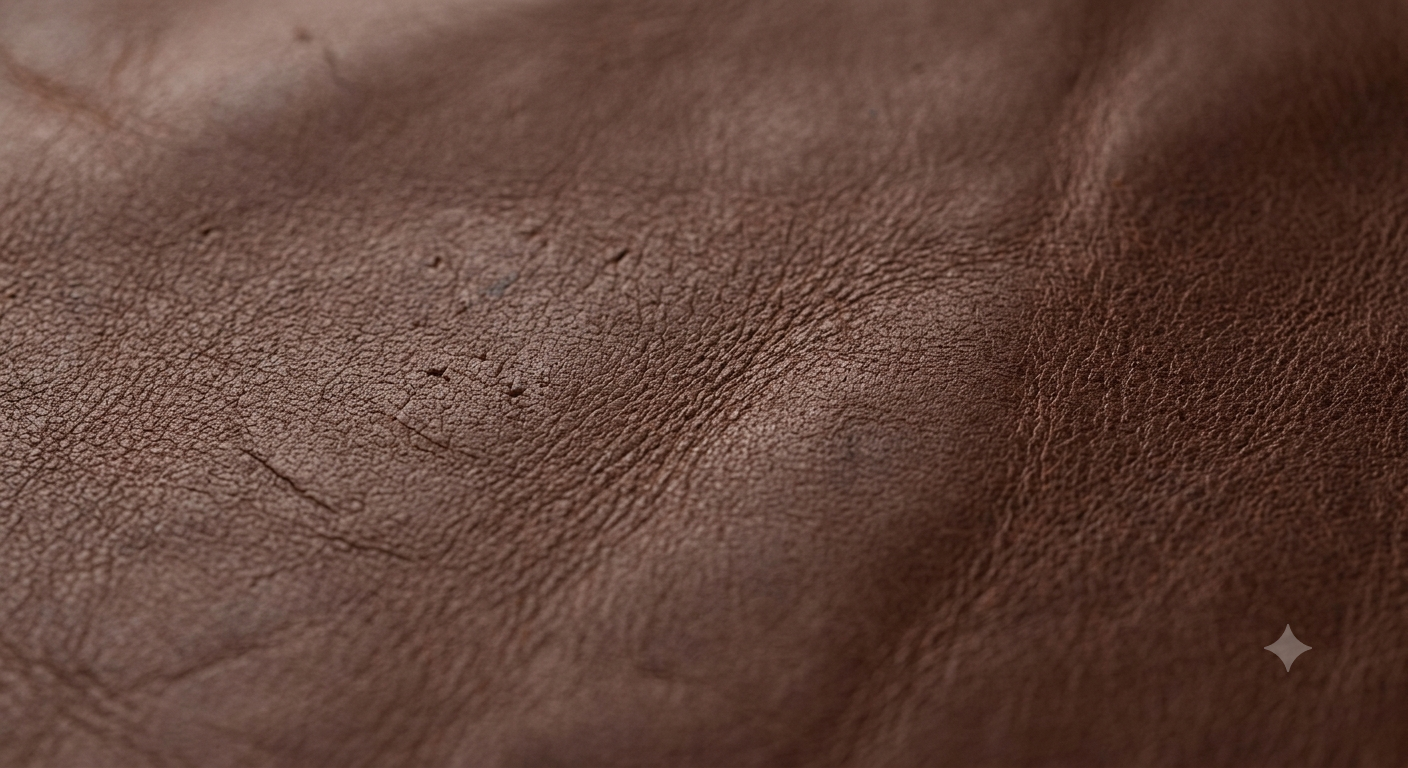
The second-best grade. The surface has been lightly sanded or buffed to remove imperfections, then a finish coat is applied. More uniform looking than full-grain, still durable, but develops little patina and is slightly thinner.
Top-grain is the most commonly used leather in high-end production goods - designer handbags, quality wallets, upholstered furniture. The surface correction makes it easier to work with, more consistent in appearance, and more resistant to immediate staining (the finish coat acts as a light barrier). The trade-off: that same finish coat reduces breathability, and the sanding removes some of the hide's natural strength. Top-grain leather is still excellent - just not quite at full-grain's level of longevity.
What to expect over time: Top-grain holds up well for 5–15 years depending on use and care. It will show surface wear eventually but generally doesn't develop the natural patina full grain does.
Common uses: High-street fashion bags, quality shoes, office furniture, car interiors.
Repair note: Top-grain leather repairs well. Color matching and surface reconditioning are straightforward, and stitching restoration is reliable. If your leather furniture or leather jacket is made from top-grain leather, it is a solid candidate for professional repair. See our leather furniture repair and leather jacket repair services.
3. Corrected-Grain Leather
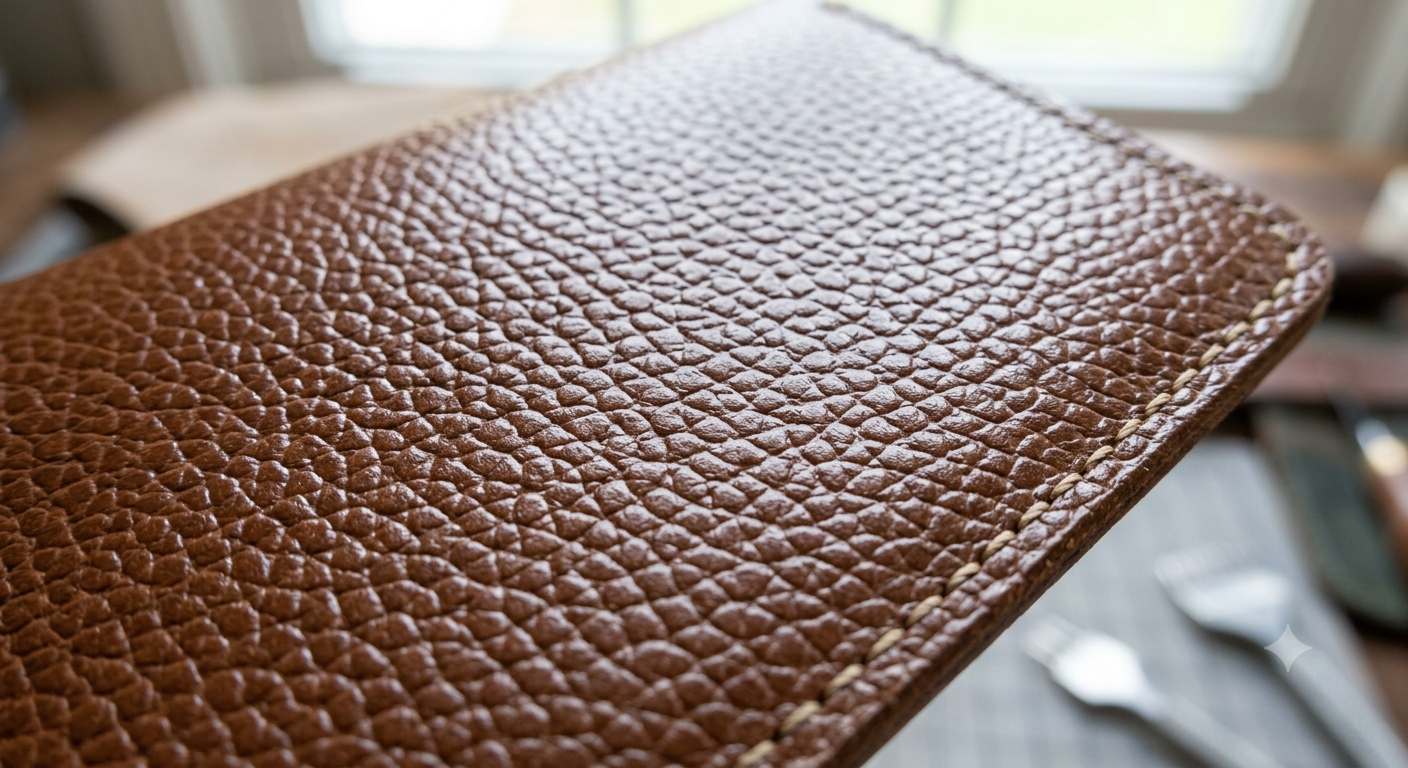
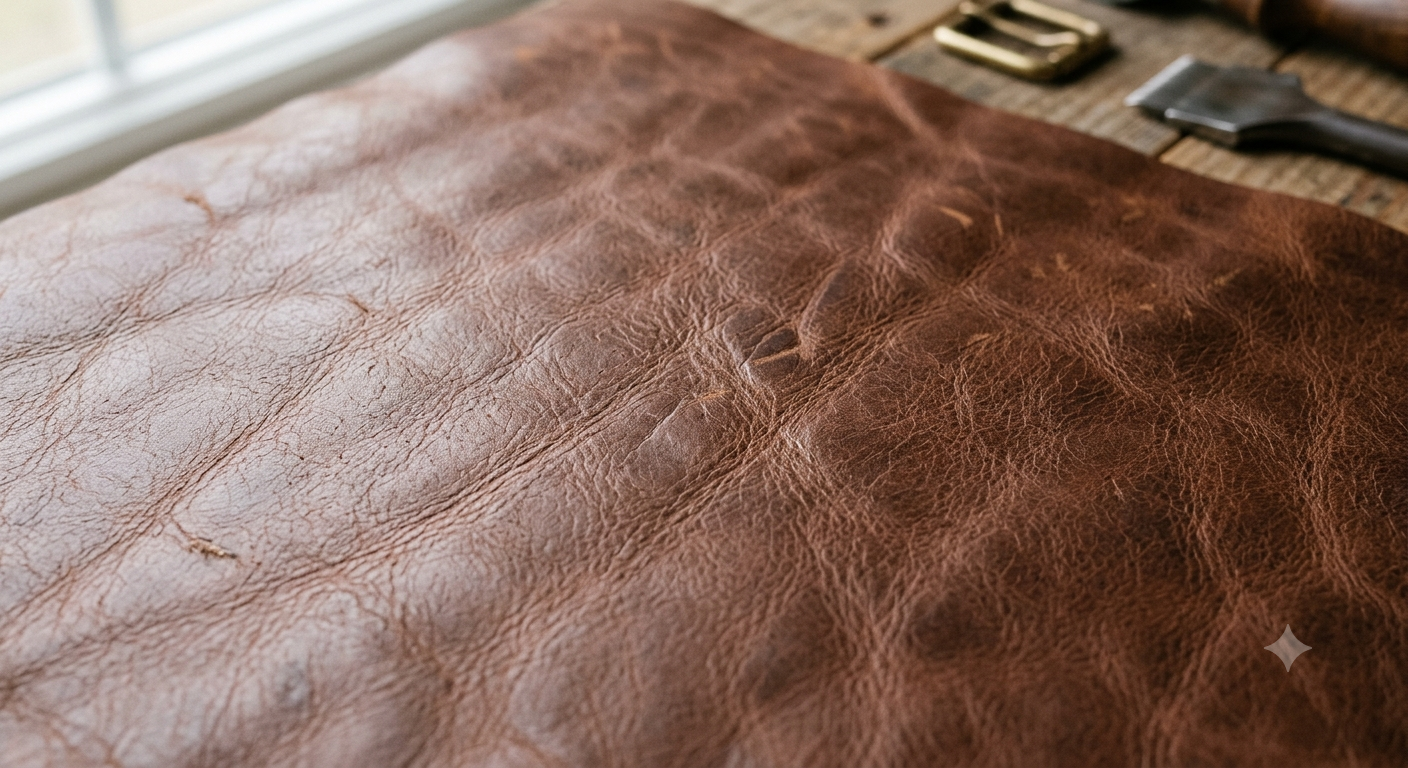
Top-grain leather where the surface imperfections have been buffed away and an artificial grain pattern stamped on. Uniform in appearance, decent durability, but lacks the natural character of full-grain or genuine top-grain.
Corrected grain is often used in furniture and everyday accessories where consistent appearance matters more than natural character. The embossed grain gives it a polished, even look, but you are looking at an artificial surface rather than the actual hide.
What to expect over time: Corrected grain holds up reasonably well, but the embossed surface can eventually wear through to the underlying layer. Color fading is more common than with aniline finishes.
Common uses: Office furniture, everyday handbags, sturdy wallets, car seats in mid-range vehicles.
4. Genuine Leather
A marketing term that sounds better than it is. "Genuine leather" means it is Real leather - but made from the inner layers of the hide left over after the top is removed. It is real, but it is the lower grades.
Here is something worth knowing before you shop: every time you see "genuine leather" as a selling point on a tag, it is actually the lowest quality of real leather. The term has no quality floor - it simply means the product contains some percentage of animal-hide leather. Genuine leather can look similar to top-grain after processing (artificial dyes, pattern embossing, spray coatings), but the underlying fiber structure is looser and weaker. It wears faster, cracks sooner, and does not age the same way as full-grain or top-grain.
What to expect over time: Genuine leather products typically show significant wear within 3–7 years with regular use.
Common uses: Budget accessories, belts, casual shoes, lower-priced wallets.
Repair note: Genuine leather can be repaired, but the results are more limited because the underlying material has less structural integrity than higher grades.
5. Split Leather
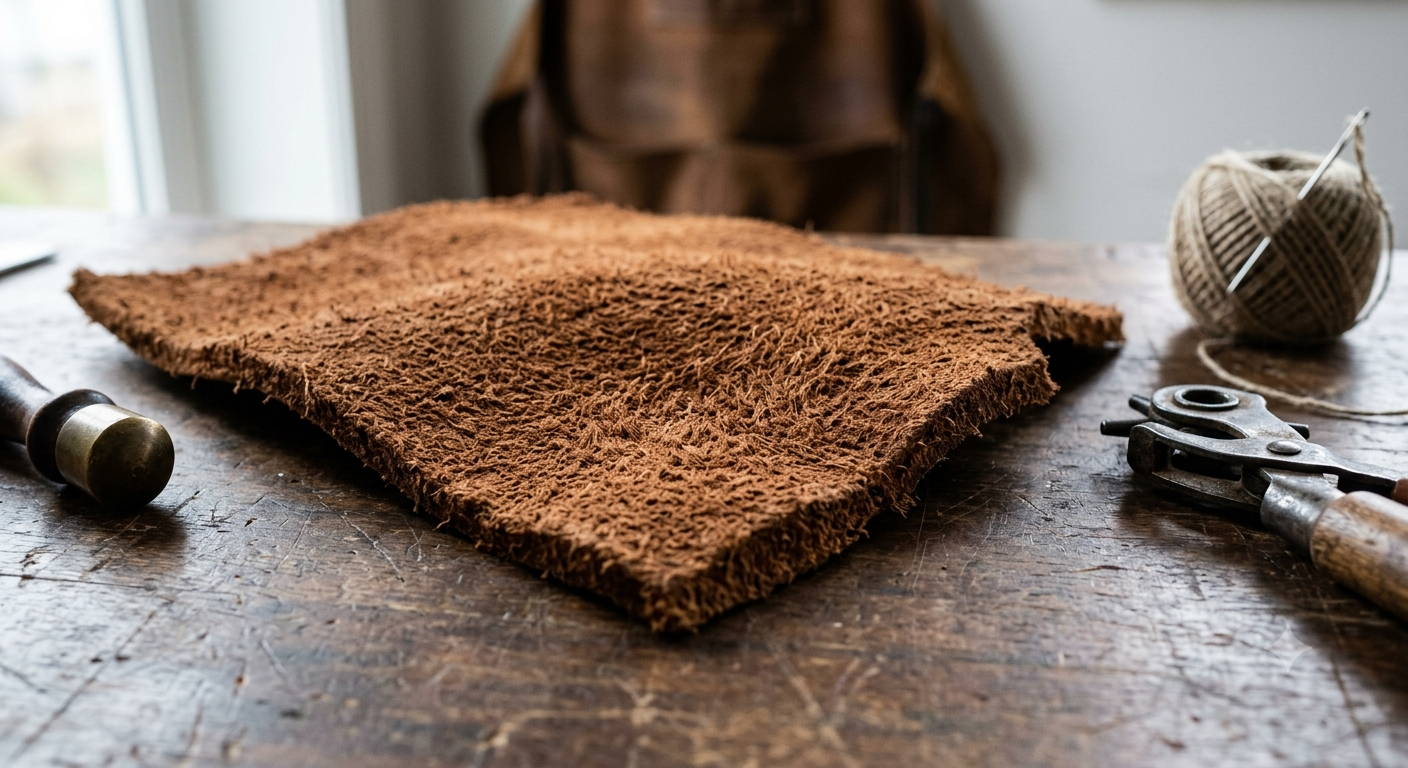
The fibrous bottom layer of the hide after the top is removed. Less durable than higher grades but still used widely in suede, work gloves, lining material, and some lower-cost goods.
Split leather is not inherently bad - it has legitimate uses where flexibility and a specific texture are needed more than raw strength. Suede, for example, is often made from split leather (or the underside of a split), which is why it has that soft, napped surface.
What to expect over time: Split leather products wear faster than top-grade leather and can crack or tear under stress.
Common uses: Suede-faced goods, bag linings, work gloves, belts reinforced with another material, upholstery in budget furniture.
6. Bonded Leather
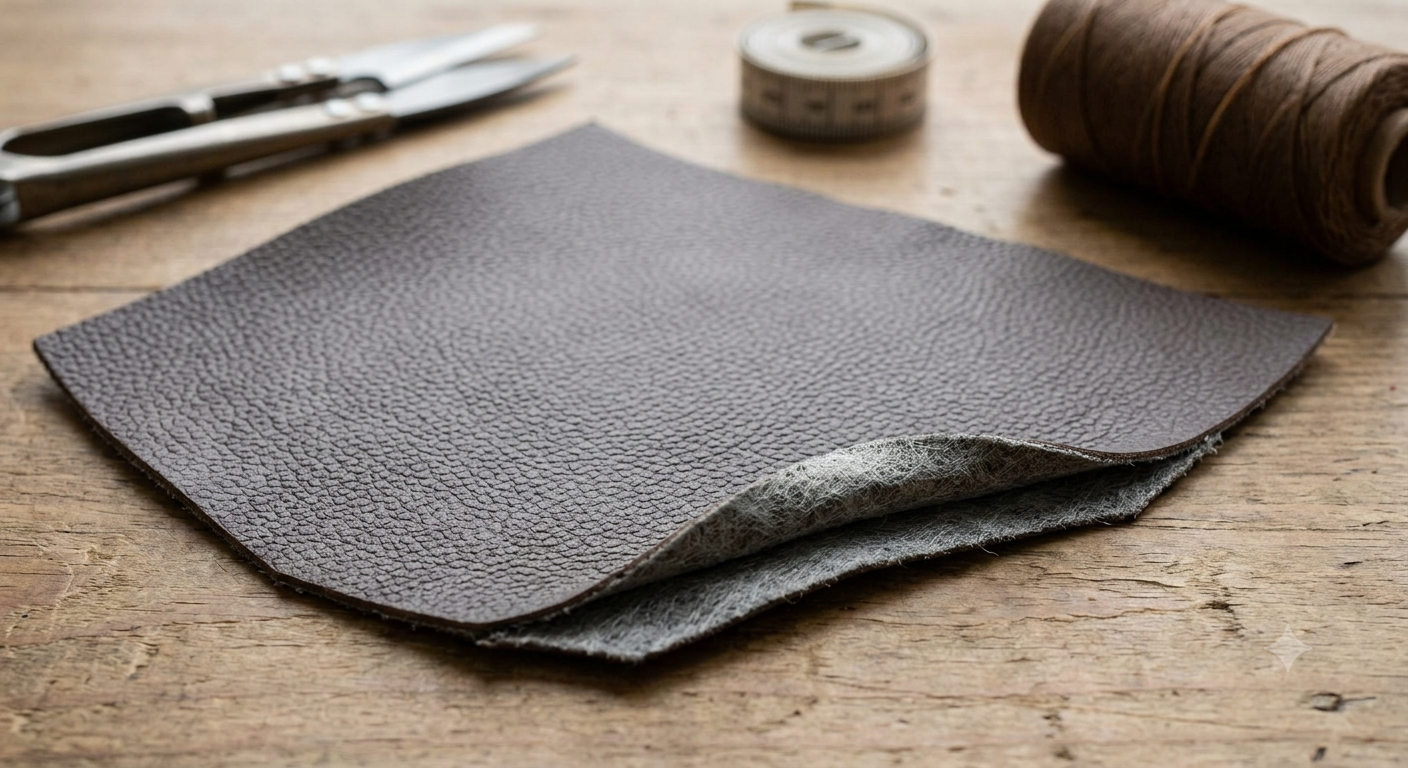
The lowest grade -and the only one we actively advise most buyers to avoid for anything they want to keep long-term. Made from shredded leather scraps bonded together with polyurethane or latex, it peels rather than cracks and cannot be repaired the way real leather can.
Bonded leather exists because it allows manufacturers to use the words "leather" in marketing while using as little real hide as possible. The actual leather content can be anywhere from 10% to 90% of the material. The characteristic failure mode of bonded leather is peeling - not cracking. The bonded surface literally separates from the backing in flakes or sheets. This typically starts happening within 3–5 years of regular use. Once it begins, it accelerates.
What to expect over time: Bonded leather sofas and chairs often start peeling within 2–5 years. Wallets and bags may last slightly longer depending on how they're used.
Repair note: Bonded leather is the most difficult to repair well. Patches rarely blend seamlessly because there is no structural leather fiber to anchor to. A skilled craftsman can slow the peeling and improve appearance, but results are more limited than with genuine leather grades. If your sofa or chair is bonded leather, it is worth getting a professional assessment before investing in repairs. Visit our leather furniture repair page to understand your options.
Part 2: Specialty Finish Leathers
7. Nubuck Leather
Top-grain leather that has been buffed on the grain side to create a soft, velvety surface. Looks and feels similar to suede but is stronger because it comes from the grain side (outer surface) rather than the inner side.
Nubuck is one of the more misunderstood leathers - people assume it is delicate because it feels soft, but it is actually tougher than suede. The velvet-like surface comes from sanding the outer grain rather than the inner split, so the underlying fiber structure is intact. It stains easily and requires a protective spray and specialized cleaning, but with proper care, nubuck leather goods hold up beautifully.
Common uses: High-end casual shoes, quality boots, premium bags, jackets, upholstered furniture.
8. Suede Leather
Made from the inner or split layer of the hide, giving it a characteristically soft, napped texture. Luxurious in feel and appearance but more vulnerable to moisture, staining, and wear than grain-side leathers.
Suede is not a grade - it is a finish style applied to split leather or the underside of a hide. It is lighter and more flexible than most leathers, which is why it works so well in soft accessories and fashionable jackets. The main thing to know suede and moisture do not get along. Water can permanently flatten the nap. If you own suede items, a good-quality water-repellent spray applied before first use goes a long way.
Common uses:Fashion boots, jackets, casual bags, interior accessories.
Repair note: Suede shoes and boots can often be professionally repaired - including nap restoration and sole replacement - and are absolutely worth restoring if the upper is still in good shape.
9. Patent Leather
Leather with a high-gloss lacquer or varnish coating applied to the surface. Recognizable by its mirror-like shine. Easy to clean, water-resistant, and distinctive - but not breathable, and prone to cracking if the coating ages.
Patent leather has been around since the early 1800s, originally used for formal footwear. The glossy finish is created by applying multiple layers of lacquer and then polishing - a process that completely seals the surface. The result is striking and practical for formal occasions: it resists water and stains, wipes clean easily, and maintains its shine. The downside is that the lacquer can crack or peel over years, especially if stored improperly or exposed to extreme temperatures.
Common uses: Dress shoes, evening handbags, belts, formal accessories, children's shoes.
Part 3: Leather by Tanning Method
This is where most leather guides fall short. The tanning method used on leather determines how it behaves, how it ages, and what it can be used for - often more than the grade alone.
10. Vegetable-Tanned Leather
Leather tanned using natural plant-based tannins (from tree bark, leaves, and other plant matter). The process takes weeks, produces firm, structured leather that develops a deep patina with age, and is generally considered the more sustainable option.
Vegetable tanning is the oldest method of leather production - it has been used for thousands of years. The hides are soaked in natural tanning solutions made from bark, chestnut, oak, or other plant sources. The process is slow (weeks to months depending on thickness) but produces leather with exceptional character. Vegetable-tanned leather starts firm and stiff. As you use it, it gradually conforms to your hand, your foot, your body - developing a personalized shape and a rich patina that darkens and deepens over years. The global market for vegetable-tanned leather is expected to grow at a CAGR of 4.3% through 2027, driven in part by sustainability-conscious buyers. (Source: Meticulous Research)
What to expect over time: Vegetable-tanned leather ages like fine wood. The more it is used and handled, the better it looks.
Common uses: Belts, high-quality wallets, holsters, saddles, watch straps, leather-covered journals, artisan bags.
11. Chrome-Tanned Leather
Leather tanned using chromium salts - a fast, efficient process (hours vs. weeks) that produces soft, flexible, water-resistant leather in a wide range of colors. The most common form of leather in commercial production today.
Chrome tanning was developed in the 1800s as a faster alternative to vegetable tanning. Today, the majority of commercial leather worldwide is chrome-tanned. It produces a consistently soft, pliable hide that dyes easily and resists water better than vegetable-tanned alternatives. The environmental trade-off is real: chromium salts require careful handling and disposal. Responsible tanneries use closed-loop systems to manage this, but it is worth knowing when making sustainable choices.
What to expect over time: Chrome-tanned leather is more stable in varying conditions than veg-tanned leather but develops less patina and character over time.
Common uses: Most commercial shoes, jackets, bags, car interiors, upholstered furniture.
12. Aniline Leather
Leather dyed exclusively with transparent, soluble aniline dyes - no surface coating. The most natural-looking leather you can find. Shows the grain, scars, and every natural variation of the hide in full. Highly susceptible to staining but extraordinary in appearance.
Aniline leather is leather in its most honest form. Because no protective coating is applied, you are seeing and touching the actual grain of the hide. Every piece is completely unique. It is the softest, most natural-feeling leather - and also the most vulnerable. A single water drop on aniline leather will leave a temporary mark. Oils from hands will slowly darken it over time (in a beautiful way). Sunscreen, denim dye, and food spills can permanently stain it.
What to expect over time: Aniline leather ages magnificently - but only with proper care. It builds one of the most beautiful patinas of any leather type.
Common uses: High-end sofas and chairs, premium handbags, heritage-quality accessories.
13. Semi-Aniline Leather
Aniline-dyed leather with a very light protective surface coating applied. Balances the natural beauty of aniline leather with meaningful stain and scratch resistance. The most practical choice for luxury furniture.
Semi-aniline is the sweet spot for most buyers who want natural-looking, beautiful leather that can actually survive daily life. The light protective coating is thin enough that the natural grain is still visible, but substantial enough to resist most common stains.
Common uses: Quality sofas, automotive interiors in premium cars, upholstered office chairs, high-end accessories.
Repair note: Semi-aniline leather responds very well to professional upholstery repair. Color matching and surface reconditioning are effective, and the results tend to be highly satisfying.
Part 4: Exotic & Alternative Leathers
14. Exotic Leather
Leather made from non-cattle hides - crocodile, alligator, python, ostrich, stingray, lizard, and others. Each has a distinctive texture and pattern. Rare, expensive, and regulated. Used almost exclusively in luxury fashion and accessories.
Exotic leathers are in a class of their own. Crocodile and alligator leather feature the distinctive scale pattern most associated with luxury goods. Ostrich leather is known for the quill follicle pattern on its surface and its extraordinary softness. Python offers striking natural markings with a supple feel. Stingray is exceptionally durable with a pebbled, bead-like surface. These leathers are subject to international regulations, particularly for endangered species. CITES (the Convention on International Trade in Endangered Species) governs the legal trade of many exotic leathers - reputable sources will have documentation.
Common uses: Luxury handbags, designer belts, watchbands, exclusive wallets, high-fashion shoes.
15. Faux / Vegan Leather
Synthetic material designed to look and feel like real leather without using animal hides. Most commonly made from polyurethane (PU) or polyvinyl chloride (PVC). More affordable, easier to clean, available in unlimited colors - but typically lasts 3–5 years before cracking, peeling, or losing texture.
Faux leather has improved significantly in recent years. Modern PU leather in particular can look convincingly similar to top-grain leather on first inspection. It is also more resistant to moisture and doesn't require conditioning. The honest trade-off: even the best faux leather does not last as long as real leather, does not breathe, and cannot be repaired the way natural hides can. When it degrades, it typically peels in a similar way to bonded leather. For those with ethical or budget-driven reasons to choose faux leather, it is a legitimate option - as long as you go in with accurate expectations.
How to Tell Leather Quality: 5 Simple Tests
You can identify real that high-quality leather using five simple checks - no lab required.
1. The Texture Test
Look at the surface closely - ideally with a phone camera. Real, high-grade leather (full grain especially) will have a slightly irregular grain pattern. No two areas look exactly the same. Faux leather and bonded leather have a perfectly uniform, repeating pattern. Too perfect means artificial.
2. The Water Drop Test
Put a single small drop of water on the surface. Real leather - especially full-grain and aniline - will absorb the drop slightly (you'll see it darken for a moment). Top-grain and corrected-grain leather will repel it slightly due to the finish coat, but not completely. Faux leather and bonded leather repel water entirely and the drop sits on the surface without any change.
3. The Temperature Test
Hold your hand against the surface. Real leather is slightly cool to the touch and warms with your hand within a few seconds. Faux leather and bonded leather don't transfer temperature the same way - they tend to stay at room temperature or feel slightly plasticky.
4. The Smell Test
Real leather has a distinctive natural, earthy smell - slightly musky and organic. This comes from the tanning process. Bonded leather and faux leather often have a slight plastic or chemical smell, especially when new. If it smells like a car showroom or a hardware store, be skeptical.
5. The Edge Test
Look at the cut edges of the leather (inside a bag, on a belt, on a wallet flap). Real full-grain and top-grain leather will show a fibrous, natural cross-section. Bonded leather will often show a fuzzy or layered cross-section with a fabric backing visible. Genuine leather and split may show a thinner edge.
How Each Leather Type Ages Over Time
Full-grain and vegetable-tanned leather get better with age. Top-grain holds steady. Genuine leather and bonded leather deteriorate significantly within 5–10 years.
| Leather Type | 1 Year | 5 Years | 10+ Years |
|---|---|---|---|
| Full-Grain | Barely changed, slight softening | Rich patina developing, conforming to use | Deep patina, extraordinary character — heirloom-quality |
| Top-Grain | Slight softening | Surface wear showing, holds shape | Gradually wears, may need conditioning, still functional |
| Corrected-Grain | Consistent appearance | May show surface wear on embossed pattern | Embossing can wear through, fading possible |
| Genuine Leather | Looks similar to purchase | Cracking or stiffening starts | Significant wear, cracking, likely replacement territory |
| Bonded Leather | Fine | Peeling may begin | Severe peeling, likely unusable |
| Vegetable-Tanned | Stiff, slightly raw-looking | Softened, patina begun | Rich, deep color; uniquely yours |
| Aniline | Slight darkening from handling | Beautiful aged tone developing | One of the finest aged appearances of any leather type |
| Semi-Aniline | Consistent, minimal change | Holds up very well | Still attractive, may benefit from conditioning |
| Nubuck | Nap may flatten slightly with use | Requires maintenance, nap can be restored | Holds up well with brushing and care |
| Suede | Clean and new | Shows wear in high-contact areas | Requires regular maintenance to stay looking good |
Which Leather Type Needs Which Kind of Repair?
The better the leather grade, the better the repair results. Full-grain and top-grain respond excellently to professional restoration. Bonded leather has significant limitations.
Most people reach out to us after years of use, when something they love has started showing wear. Here is an honest breakdown by leather type:
Full-Grain & Top-Grain Leather - Best Repair Candidates
These leathers repair beautifully. Whether it's a cracked jacket, a worn shoe sole, a scuffed sofa, or a bag with a broken strap - we can restore them to near-original condition. Color matching is effective, stitching holds, and reconditioning brings the suppleness back.
Leather jackets in full or top-grain leather: stitching, zipper replacement, lining repair, crack reconditioning
Shoes and boots: sole replacement, heel rebuilding, leather reconditioning, stitching
Furniture: crack filling, color restoration, structural repair
Bags and purses: strap repair, zipper replacement, lining restoration
Upholstery (car seats, chairs, sofas): patch repair, color matching, surface reconditioning
Genuine Leather & Split Leather - Good Repair Candidates with Expectations
Genuine leather can be repaired, but results depend on how far the deterioration has gone. If the surface is cracking but the structure is intact, surface treatments and color restoration are effective. If the leather has become brittle throughout, repairs have limits.
Bonded Leather -Limited Repair Candidates
Bonded leather peels rather than cracks, and patch repairs rarely blend well. A professional can apply stop-gap treatments to slow peeling, improve appearance, and extend usable life - but bonded leather generally cannot be restored to original condition. Honest advice: if a bonded leather sofa is in advanced peeling, the conversation is often about whether repair or replacement makes more financial sense.
Aniline & Semi-Aniline -Excellent Repair Candidates
These leathers respond very well to professional conditioning and color treatment. Because they absorb products deeply, reconditioning treatments are highly effective. Scuff repair and scratch treatment on aniline sofas is some of the most satisfying work we do.
Buyer Mistakes to Avoid
These are the patterns we see again and again from people who come to us after a purchase gone wrong.
Mistake 1: Assuming "genuine leather" means good quality. It doesn't. "Genuine leather" is the minimum standard - not a quality badge. If quality matters, look for "full-grain" or "top-grain" specifically.
Mistake 2: Buying bonded leather furniture without knowing it. If you see leather furniture priced significantly below what you'd expect for real leather, it is almost certainly bonded leather. The tell check the edges and look for a fabric backing.
Mistake 3: Ignoring tanning method when buying accessories. If you want a belt or wallet that lasts 20 years, vegetable-tanned leather is the right choice. If you just want a nice-looking bag at a fair price, chrome-tanned is fine. Knowing the difference lets you match expectation to product.
Mistake #4: Not protecting leather before first use. Conditioning and waterproofing leather before the first use gives it meaningful protection against staining and cracking. Most people skip this step.
Mistake 5: Waiting too long to repair. The most common thing we hear is "I should have brought this in sooner." Leather damage almost always gets worse over time, not better. A small crack that costs $50 to fix today can become a structural failure that costs much more - or makes the item irreparable - if left for another year.
Final Thoughts
Leather is one of those materials that rewards knowledge. Once you know the difference between a full-grain wallet that will last 30 years and a bonded leather one that will start peeling in three, you shop differently. You maintain what you own more carefully. And when something you love shows wear, you know it is worth repairing rather than replacing.
At Lebanon Leather Work, we have been working with leather for decades - repairing pieces people thought were beyond saving, crafting goods from scratch, and working with everything from everyday accessories to designer furniture. If something in your home or wardrobe needs attention, we are happy to take a look.
Identify your leather type above then bring it to us. Lebanon Leather Work (Lebanon, NJ) has repaired every leather type listed on this page - furniture, bags, shoes, jackets, and custom goods. Book a Free Consultation
Frequently Asked Questions
What is the highest quality type of leather? Full-grain leather is the highest quality leather available. It comes from the outermost layer of the hide with the natural grain completely intact. Only a small percentage of any hide qualifies, which is why it carries a premium - and why it lasts decades.
What is the difference between full-grain and top-grain leather? Full-grain leather keeps the entire natural grain intact with no sanding or buffing. Top-grain leather has the surface sanded or corrected to remove imperfections and a finish coat applied. Top-grain looks smoother and more uniform; full-grain looks more natural and ages with a richer patina.
Is genuine leather good quality? Genuine leather is real leather, but it is one of the lower grades - made from the inner layers of the hide after full-grain and top-grain have been removed. It is more affordable but wears out faster and doesn't age as gracefully. The term "genuine leather" is not a quality endorsement.
What is the difference between vegetable-tanned and chrome-tanned leather? Vegetable-tanned leather uses natural plant-based tannins and takes weeks to produce. It starts stiff and develops a beautiful patina with use. Chrome-tanned leather uses chromium salts and takes hours to produce. It is softer from the start, more water-resistant, and better for colorful fashion goods. Most commercial leather is chrome-tanned.
Can bonded leather be repaired? Yes, to a point - but bonded leather is the hardest type to repair well. Because it is made from shredded scraps bonded with polyurethane, it peels in layers rather than cracking, and seamless patch repairs are difficult. Professional restoration can slow peeling and improve appearance but cannot fully restore bonded leather to original condition.
How can I tell if leather is real or fake? Real leather has a slightly irregular grain pattern, absorbs a water drop slightly, warms to your touch, and has a natural earthy smell. Faux and bonded leather have a perfectly uniform pattern, repel water completely, stay at room temperature, and may smell slightly plastic or chemical.
What type of leather is best for furniture? For furniture that sees heavy use, semi-aniline or pigmented top-grain leather is the most practical balance of beauty and durability. Full-grain aniline leather is the most luxurious but requires more care. Avoid bonded leather for any furniture you want to keep for more than a few years.
What type of leather is best for shoes? Full-grain leather is ideal for quality shoes and boots - it molds to your foot, breathes naturally, and can last decades with proper care. Top-grain is a solid middle-ground. For dress shoes, calfskin (a premium full or top grain hide from young cattle) is the traditional choice.
How often should I condition leather? For items in regular use (shoes worn several times per week, bags used daily), conditioning every 3–6 months is a good general rule. For furniture, once or twice a year is usually sufficient. Leather in dry climates or under frequent sunlight exposure may need conditioning more often.
What is the difference between nubuck and suede?Both have a soft, velvety surface - but they come from different parts of the hide. Nubuck is made from the grain side (outer surface) of top-grain leather, sanded to create the nap. Suede is made from the inner or split side of the hide. Nubuck is stronger and more durable because it uses the outer, denser layer.0