
Car Upholstery Materials Explained
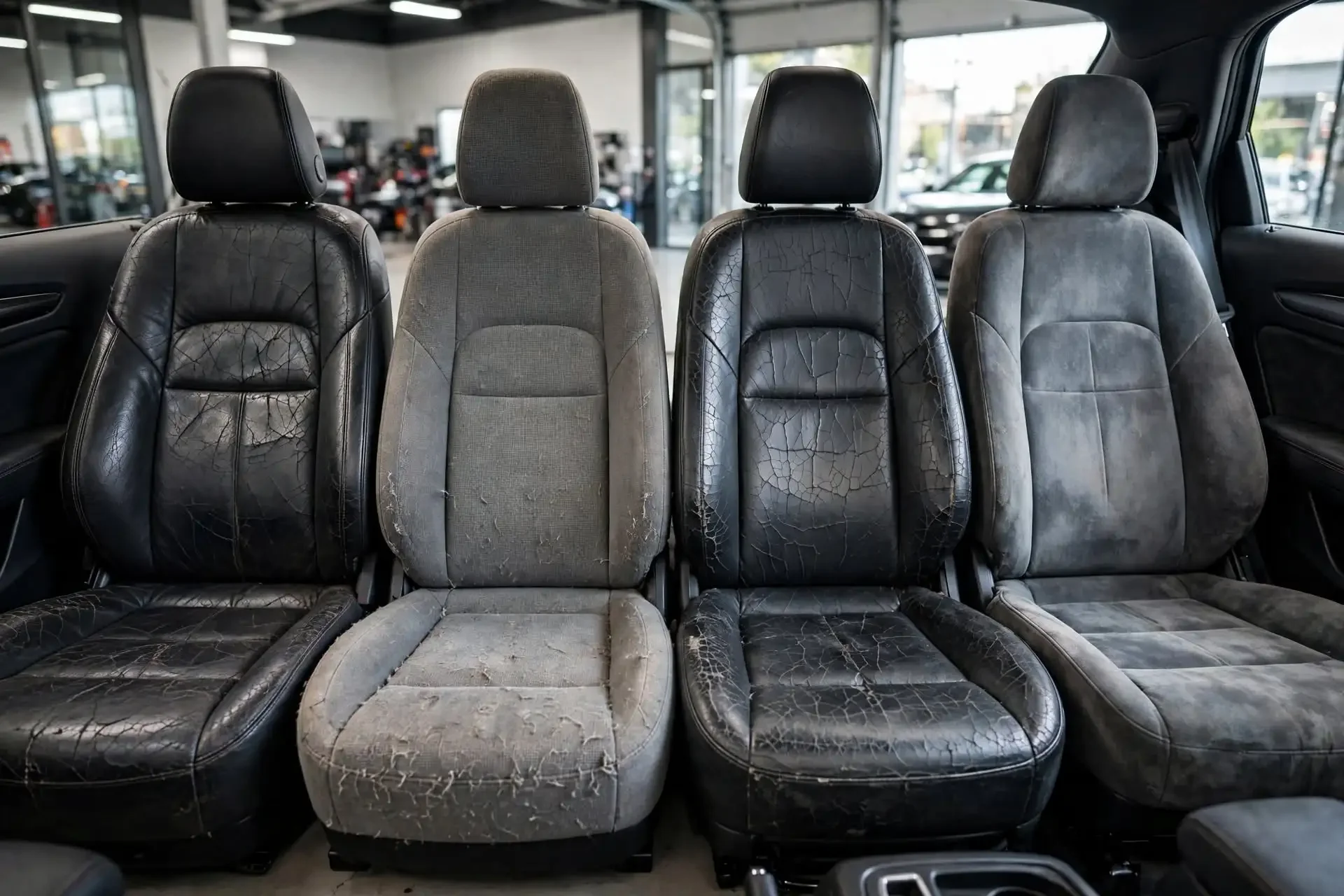
Most guides on car upholstery material tell you leather is premium, vinyl is easy to clean, and cloth is budget friendly. That's roughly as useful as a restaurant review that says the food is "edible." You already knew that.
What you probably don't know is what your seats actually look like in year three, year five, and year eight and what it costs to bring them back.
We see the results every week. After 35 years of restoring automotive upholstery at Lebanon Leather Work in New Jersey, we've watched every material fail in predictable ways, hold up beautifully in the right application, and get mismatched to the wrong driver. This is what we tell customers when they ask which material to choose for a re-upholstery job or a repair.
What Automotive Upholstery Material Actually Means
Car upholstery material refers to any covering used on a vehicle's seats, door panels, headliner, and interior trim. The main categories genuine leather, leatherette and PU, vinyl, and cloth differ in feel and price, yes. But the variable most guides skip entirely is repairability: whether the damage those materials develop over time can be fixed, and what it costs when you do.
That's the lens we use here.
Full-Grain and Top-Grain Leather
Genuine leather splits into two tiers worth knowing. Full grain uses the complete hide surface pores, natural markings, everything intact. Top-grain has the surface buffed and an artificial finish applied, making it more uniform and slightly more stain-resistant out of the gate. Most factory luxury car installations use top-grain because it's easier to manufacture consistently at scale.
Year 5 reality: Full grain develops a patina. Oils from your skin and daily UV exposure begin deepening the color unevenly, most visibly on the seat bolsters. Top-grain shows fading on the horizontal cushion face first the surface that takes the most direct sun.
Year 10 reality: With conditioning twice a year, a full-grain leather interior can genuinely still look good at a decade. Without it, expect surface cracking on the seat back, color lift on high-contact areas, and stiffness where the hide has dried out.
The repair reality: Leather is the most repairable auto seat upholstery material we work with. A crack caught early 3 to 4 millimeters wide, not yet through the hide can be filled, color-matched, and finished so cleanly you'd need to know where to look. A full bolster restoration on a driver's seat typically runs $150–$300 at a professional shop. Done right, it's indistinguishable from factory.
Choose it if you're keeping the car 10+ years, want an interior that rewards maintenance, and are willing to condition it twice a year. Resale value holds noticeably better with a well-maintained leather interior.
Leatherette, PU, and Bonded Leather the Category That Needs a Warning
This is where most car owners get surprised. Leatherette (also called PU leather, faux leather, vegan leather, or bonded leather in its cheaper form) looks like genuine leather off the shelf. In the first two years, you often can't tell them apart.
After that, the categories diverge sharply.
Quality PU BMW Sensa Tec, Mercedes MB-Tex, or commercial-grade aftermarket like Naugahyde Auto holds up well through year 4–5. Flaking isn't inevitable at this stage, especially if you avoid harsh cleaners and keep the interior out of sustained direct sun.
Bonded leather is a different material entirely. It's made from leather scraps and fiber pulp pressed together and glued to a polyurethane backing. In our shop, we see it start peeling around year 3 horizontal strips, almost always beginning at the seat bolster edge where your thigh contacts the seat.
Once bonded leather starts peeling, it cannot be repaired. The delamination continues underneath the surface even if you patch over it. We tell customers this plainly: if bonded leather is peeling, the correct answer is replacement, not repair. No filler holds because there's no stable substrate left to bond to.
The repair reality: Quality PU can be patched, filled, and color-matched with results close to genuine leather. Bonded leather at the delamination stage cannot. This distinction matters far more than the price difference upfront a $200 upgrade to quality PU over bonded leather can prevent a $600 full re-cover job four years later.
Choose it if you want leather aesthetics without a conditioning routine and you're planning to trade the car within 5–7 years. Before buying, ask for the double-rub count (100,000+ for a quality material) and confirm whether the construction is true PU or bonded.
Vinyl
Vinyl gets undersold. It's the workhorse of automotive upholstery the car seat fabric in trucks, fleet vehicles, commercial interiors, and marine applications. In the right context, quality vinyl outlasts leather.
Year 5 reality: Surface wear shows on high-contact areas, particularly the driver's bolster. Cracking is possible if the vehicle sits in direct sun without a sunshade in a hot climate. Quality marine-grade vinyl in a standard vehicle interior? Minimal visible change.
Year 10 reality: With basic care monthly wipe-down, a sunshade when parked outside vinyl holds its color and surface well. It doesn't develop patina the way leather does. What you start with is largely what you have at year 10, just a shade more worn.
The repair reality: Vinyl patches cleanly. A tear gets a sub-patch backing, filler, and a color-matched topcoat. Texture matching isn't always perfect on heavily embossed grain patterns, but a professional automotive upholstery repair on vinyl is less visible than most people expect before they've seen it done.
Choose it if you drive a work truck, have kids and dogs in the car regularly, or need an interior that wipes clean after every trip. Fleet managers already know this. Everyone else tends to underestimate vinyl until they've owned a leather interior through two New Jersey winters and a summer of beach parking.
Cloth and Fabric (Polyester, Nylon, Velour)
Cloth is the most comfortable car seat fabric for most climates. It doesn't bake in summer, doesn't stiffen in cold weather, and it breathes in ways leather and vinyl don't. There's a reason it ships standard on most vehicles.
The tradeoffs are staining and wear visibility.
Year 5 reality: Color holds reasonably well on quality polyester and nylon blends. The bolsters where you slide in and out every day show friction wear first. Spills absorbed into cloth are essentially permanent if not treated within the first few minutes. Pet hair is an ongoing battle that no vacuum fully solves.
Year 10 reality: Noticeable fading on sun-exposed surfaces, potential pilling on high-friction zones. A quality cloth interior still functions fine at a decade. It just looks used, in a way that leather can age out of and cloth can't.
The repair reality: Cloth is the hardest automotive upholstery material to repair invisibly. Color-matching a replacement panel to aged fabric requires sourcing period-correct material, which isn't always available for older vehicles. A full re-cover is often more practical than a patch and because cloth is the least expensive auto seat upholstery material to source and install, that outcome doesn't have to be painful.
Choose it if you prioritize comfort in four-season climates, don't need the interior to look showroom-fresh at year 8, or you're keeping costs low on a vehicle you're not attached to long-term.
Alcantara, Neoprene, and Specialty Options
Alcantara is a branded synthetic microsuede used by Porsche, Ferrari, and most performance manufacturers. Excellent for grip which matters in a car you're pushing through corners lighter and more breathable than leather and visually striking in the right interior. It also stains. Hair oil, sunscreen, and denim dye transfer leave marks if you don't catch the spill immediately. High-maintenance material that rewards careful owners and punishes careless ones.
Neoprene is the right call for vehicles that regularly get wet a beach truck, a hunting rig, a boat-trailer vehicle. Waterproof, resistant to salt and sand, and wipes completely clean. It gets hot in summer. But it does exactly what it's supposed to.
The repair reality: Alcantara can be professionally cleaned and partially restored; significant wear usually means panel replacement. Neoprene patches well.
Material Comparison Table
| Material | Durability | Comfort | Maintenance | Repairability | Avg. Lifespan |
|---|---|---|---|---|---|
| Full-grain leather | ★★★★★ | ★★★★☆ | Moderate (condition 2×/yr) | Excellent | 15-25 yrs |
| Top-grain leather | ★★★★☆ | ★★★★☆ | Moderate | Excellent | 10-20 yrs |
| Quality PU / leatherette | ★★★☆☆ | ★★★★☆ | Low | Good | 7-12 yrs |
| Bonded leather | ★★☆☆☆ | ★★★☆☆ | Low | Poor (replace, don't repair) | 3-6 yrs |
| Vinyl | ★★★★☆ | ★★★☆☆ | Very low | Good | 10-18 yrs |
| Cloth / polyester | ★★★☆☆ | ★★★★★ | Low-moderate | Fair | 8-14 yrs |
| Alcantara | ★★★★☆ | ★★★★★ | High | Fair | 10-15 yrs |
| Neoprene | ★★★★☆ | ★★★☆☆ | Very low | Good | 10-15 yrs |
The Repair Cost Argument Nobody Makes
A surface crack in full-grain leather costs $75–$150 to repair professionally when caught early within the first six months of appearing. The same crack left for 18 months turns into a split, the surrounding hide dries and contracts around it, and now you're looking at $300–$500 for a panel restoration.
Vinyl with a small puncture patches for $80–$120 when caught early, invisible to anyone not specifically looking for it. Ignored for a year, the cut edges lift and spread, and the surrounding vinyl becomes brittle. The repair footprint triples.
This pattern holds across every automotive upholstery material we've worked on. Damage caught early is always a small job. Damage left until the owner can't stand looking at it is always a large one.
The material choice matters. The maintenance habit matters more.
Frequently Asked Questions
Q1: What is car upholstery made of?
Car upholstery is made from leather, vinyl, cloth (polyester or nylon), PU leatherette, or specialty materials like Alcantara and neoprene. Most factory interiors use top-grain leather for luxury vehicles and woven polyester for standard models. The exact material affects durability, comfort, repairability, and how the interior ages over time.
Q2: How much does car upholstery cost?
Professional car upholstery repair costs $75–$500 depending on the damage type and material. A single crack or tear in leather typically runs $75–$200. A full seat re-cover ranges from $200–$600 per seat. Full interior re-upholstery for a standard vehicle averages $1,500–$4,000 at a professional shop.
Q3: Can you change car upholstery yourself?
DIY car upholstery repair is possible for very minor damage small tears, loose stitching, or surface scuffs using repair kits sold for under $30. Anything structural, color-critical, or covering more than a few inches is best left to a professional. Poor DIY repairs can accelerate surrounding material deterioration.
Q4: How long does car upholstery last?
Car upholstery lifespan depends on the material. Full-grain leather lasts 15–25 years with proper conditioning. Quality vinyl holds for 10–18 years. Standard cloth lasts 8–14 years. Bonded or cheap PU leather is the shortest-lived at 3–6 years before peeling, regardless of how well it is maintained.
Q5: What is the best automotive upholstery material for durability?
Vinyl is the most durable automotive upholstery material for practical use it resists UV, moisture, abrasion, and temperature extremes better than leather or cloth. For premium long-term durability, full-grain leather properly maintained outlasts every other option. Bonded leather is the least durable and typically begins delaminating within 3–4 years.
Q6: Which automotive upholstery material is easiest to clean?
Vinyl is the easiest automotive upholstery material to clean a damp cloth removes most spills instantly with no product needed. Quality PU leatherette is a close second. Genuine leather requires pH-balanced cleaners to avoid stripping its finish. Cloth is the hardest to clean; liquid spills absorb immediately and stain permanently if not treated within minutes.
Q7: What automotive upholstery materials are used in luxury cars?
Luxury vehicles most commonly use top-grain leather, Alcantara, or genuine Nappa leather for seats. Some manufacturers. Porsche, Ferrari, McLaren use Alcantara on the headliner and door panels for weight reduction. A small number of ultra-luxury models offer hand-stitched full-grain leather with contrasting piping as a bespoke option.
Q8: What type of fabric is used in car seats?
Most car seats use woven polyester or nylon fabric, chosen for its durability, UV resistance, and low cost. Some vehicles use velour (a cut-pile polyester) for a softer feel. Performance and commercial vehicles sometimes use neoprene. Fabric car seat quality varies widely look for tight weave density and UV-stabilised dye for longer lifespan.
Q9: Is fabric or leather better for car seats?
Fabric car seats are more comfortable in extreme temperatures they don't get as hot in summer or as cold in winter as leather. Leather is easier to wipe clean, more durable over time, and holds resale value better. For families with kids or pets, vinyl or quality PU offers the practical benefits of leather with easier maintenance.
Q10: How do you repair car seat fabric?
Minor car seat fabric tears can be temporarily patched with iron-on fusible tape or fabric repair adhesive. For a lasting, invisible repair, a professional uses a sub-patch backer, color-matched filler, and fabric texture coating. Cloth fabric is the hardest upholstery material to repair seamlessly; if the damage is significant, a panel re-cover often produces a better result than a patch.
Q11: What is the best car seat fabric for hot climates?
For hot climates, breathable woven cloth is the most comfortable car seat fabric it doesn't retain heat the way leather and vinyl do. If you prefer a leather look, perforated top-grain leather or perforated PU leatherette improves airflow significantly. Pair either with a UV-reflective windshield sunshade to reduce interior heat buildup when parked.
Q12: What is auto seat upholstery?
Auto seat upholstery is the material covering that wraps a vehicle's seat foam and frame including the seat face, bolsters, headrest, and sometimes the seat back panel. It is separate from the seat cushion (foam), springs, and structure underneath. Auto seat upholstery can be repaired, re-covered, or fully replaced independently of the seat frame.
Q13: How do I know what type of auto seat upholstery I have?
Check the vehicle's owner's manual or door jamb sticker, which typically lists interior material. You can also feel the texture: genuine leather has natural grain variation and a slight waxy feel; vinyl is cooler to the touch and has a uniform surface; cloth has visible weave texture. If it's already peeling or flaking, it's almost certainly bonded or PU leather.
Q14: When should I choose automotive upholstery repair instead of replacement?
Choose professional automotive upholstery repair when the damage is isolated a crack, tear, burn, or stain smaller than a hand width, affecting one seat or panel. Repair costs $75–$300 and is usually invisible when done correctly. Choose replacement when damage is widespread, the material is delaminating bonded leather, or the seat frame itself is compromised.
Q15: Does automotive upholstery repair affect resale value?
Professional automotive upholstery repair maintains or improves resale value by restoring the interior to a presentable condition. Visible tears, cracks, and stains can reduce a vehicle's trade-in value by $500–$2,000 depending on the vehicle's age and category. A $150–$300 professional repair on a leather seat typically returns more than its cost at point of sale.